
By Julia Davis / Photos courtesy of Richard Rhodes
Sculptor and master stonemason Richard Rhodes brings 5,000 years of stone knowledge to CEE.
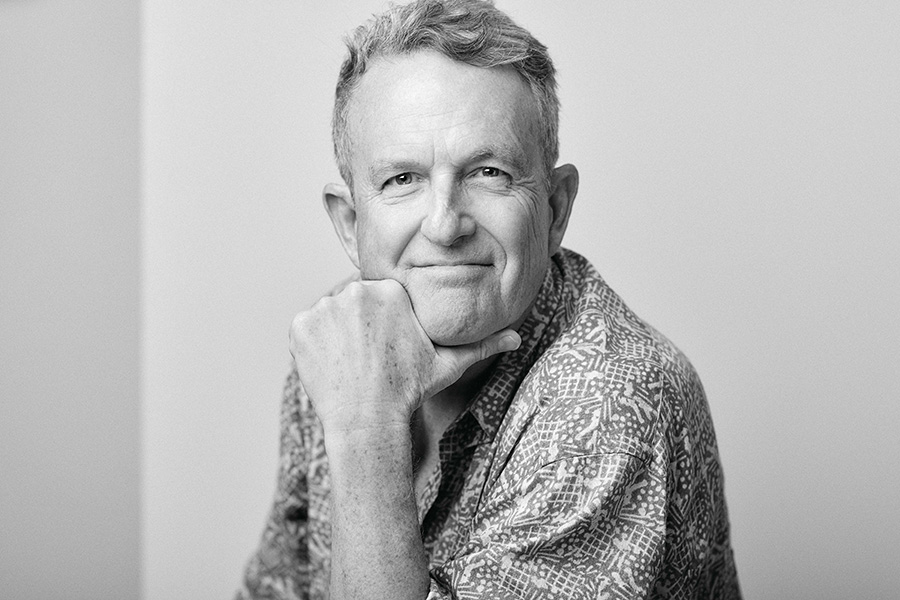
Richard Rhodes
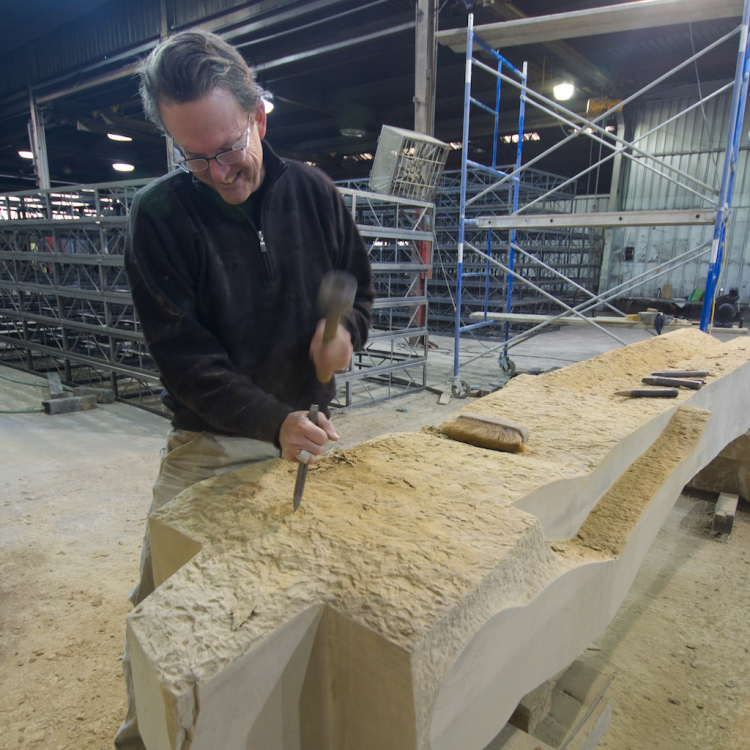
Rhodes carving stone by hand with hammer and chisel in his studio.
For more than 5,000 years, human beings have turned to stone when they want to say something that lasts. It is the material of temples, cathedrals and monuments — the way civilizations have spoken to the future. And yet, when sculptor and master stonemason Richard Rhodes arrived at the UW's Department of Civil and Environmental Engineering as the 2025-26 Burges Visiting Professor, he found that most students had never studied it.
That gap is part of what makes Rhodes such a distinctive fit for the Burges Endowed Visiting Professorship, which brings leaders from outside the UW with unique expertise to collaborate with CEE faculty and students. Rhodes brings a career spent working at the intersection of material, structure, history and art — and a deep conviction that creative thinking can strengthen civil and environmental engineering in ways that complement its existing rigor.
"The creative process can add so much value to the engineering process," Rhodes says.
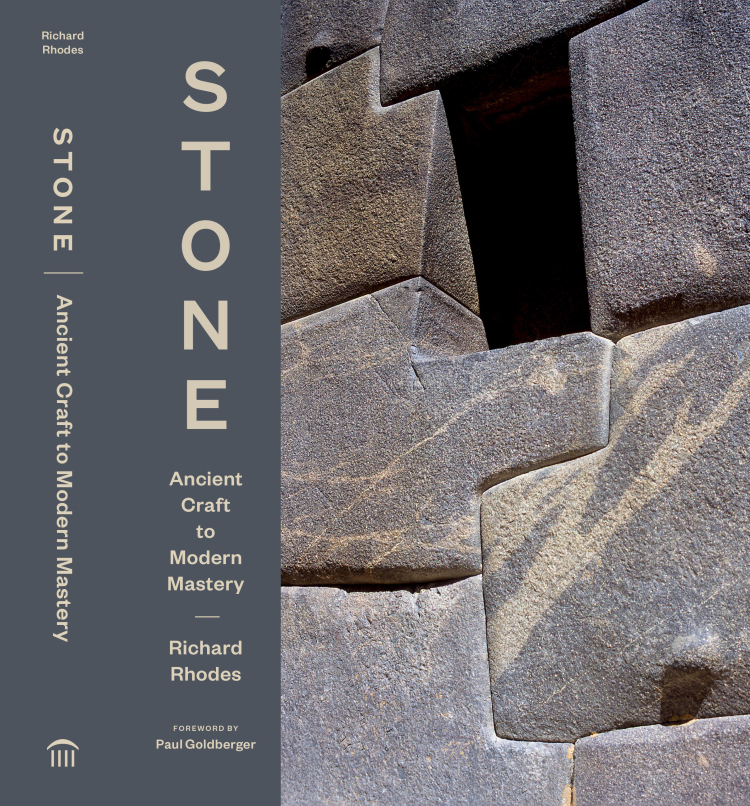
Rhodes' 2025 book, "Stone: Ancient Craft to Modern Mastery," traces 5,000 years of stone architecture and the design principles behind it.
Rhodes' appointment grew out of his 2025 book, "Stone: Ancient Craft to Modern Mastery," which traces the history of stone architecture and decodes the design principles behind it, knowledge that had largely gone unrecorded since the collapse of the European stone guilds in the 1990s. His scholarship and decades of hands-on experience offer CEE students a unique complement to their coursework: a firsthand understanding of how material, structure and design come together in practice
For Rhodes, the invitation arrived at the right moment. After more than four decades as a working sculptor and stonemason, he was looking for a way to pass forward what he had learned.
"You get to a certain point in your career, and you're looking for ways to give back," he says. "I feel a strong call to offer a leg up, if I can, to students trying to find their way."
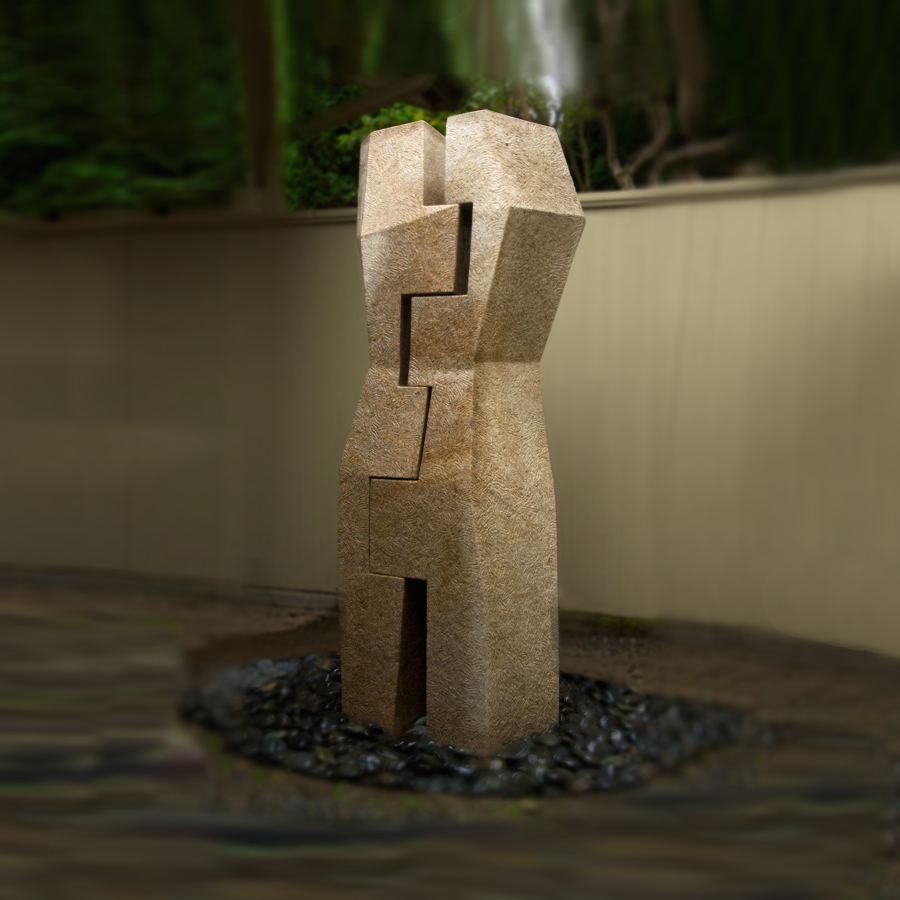
A sculpture from Rhodes' Sentinel series, designed to stand witness in open landscapes.
From medieval drama to medieval stone
Rhodes' own path to stone was anything but direct. After studying medieval drama in graduate school, he traveled to Italy for his thesis, hoping to document the traditions of Europe's oldest labor guilds. In Siena, he planned to observe the Freemasons, heirs to the continent's cathedral builders, and trace how their medieval customs had evolved within the rigid guild structure.
Instead, the work itself drew him in. The sacred geometries, the ancient rules of bond work and the deep history encoded in every wall and arch captivated him more than his original research.
"Stone sort of grabbed me, rather than me grabbing stone," he says.
He became the first non-Italian admitted into Siena's masonic guild in 726 years. Because the guild later collapsed in the mid-1990s, Rhodes became known in the sculpture and stone community as "the last apprentice." When the guild's remaining members realized their traditions would otherwise be lost, they entrusted Rhodes with preserving them. His book is the result of that charge — a 20-year effort to record knowledge that had been closely guarded for centuries.
“If you're passionate about something, and you show up and are present for it every day, you get really good at it”
Doing your scales
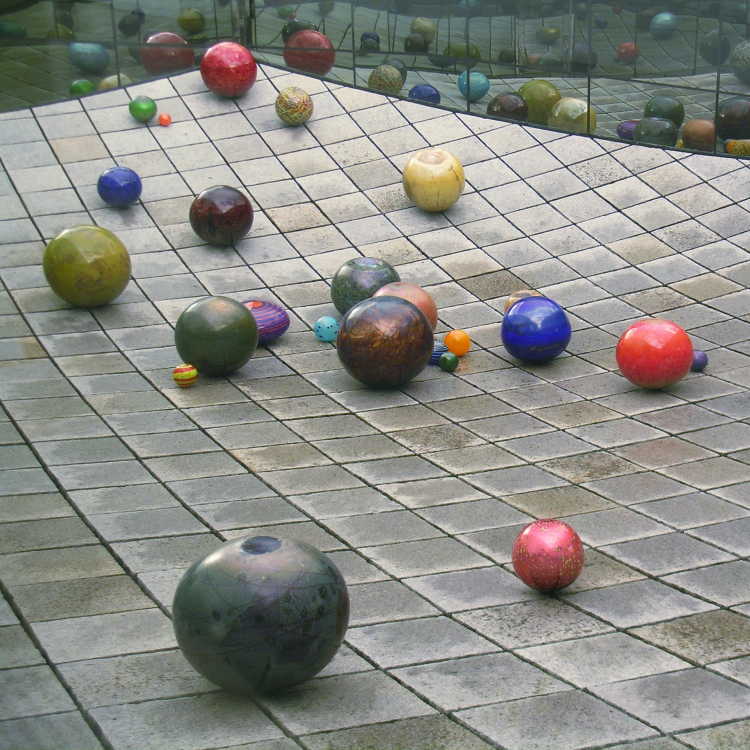
Rhodes' stone wave installation at the Tacoma Art Museum, shown with Dale Chihuly's glass companion piece.
Rhodes often compares his early career to a musician practicing scales. For years, he carved church moldings, took on commercial projects and built his technical foundation — work he describes as growing "a giant cable from your heart down your arms into your hands, so that what you feel is transferred into the object."
That long apprenticeship eventually led to major architectural commissions around the world and, later, to a full-time sculpture practice that includes public art, private commissions and work in cast bronze. Among his public works is a large-scale stone installation at the Tacoma Art Museum, where artist Dale Chihuly later created a temporary companion piece for the sculpture.
"If you're passionate about something, and you show up and are present for it every day, you get really good at it,” he says. “And then the world responds."
He has carried that message into his conversations with CEE students, many of whom are focused on landing a specific job or following a defined career track. Rhodes offers a different model shaped by curiosity, craft and the willingness to let unexpected interests reshape a life.
Where art meets engineering
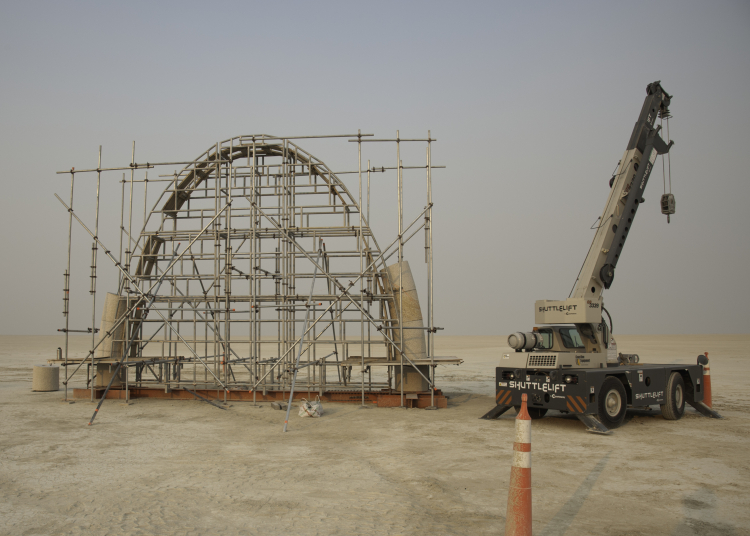
Scaffolding and a crane support the Resolute Arch during assembly on the playa at Burning Man.
If there is a single project that illustrates why a sculptor belongs in a civil and environmental engineering department, it is the Resolute Arch.
The piece — 20 feet tall, 27 feet wide and weighing 25 tons — reimagines the traditional stone arch by leaving a gap in the form. A segment is missing, yet the structure stands. It is an "open symbol," as Rhodes describes it, designed to mean different things in different contexts. Rhodes originally built the arch for Burning Man, where it won top honors and drew thousands of visitors. But making it physically possible required eight years of work and a close collaboration with structural engineer and CEE alum Robert Baxter (MSCE ’02).
The engineering challenge was enormous. A quarter million pounds of force hanging in space, lateral wind loads and a design that could not be solved by simply adding more steel. But Baxter was up for it.
What followed became, for Rhodes, a model of what artist-engineer collaboration can produce. Together, they worked through the problem from first principles, arriving at a solution that was not only structurally sound but elegant and hidden within the sculpture itself.
That experience shapes his message to CEE students: that civil and environmental engineering is strongest when it makes room for creative thinking — not as an afterthought, but as part of the problem-solving process.
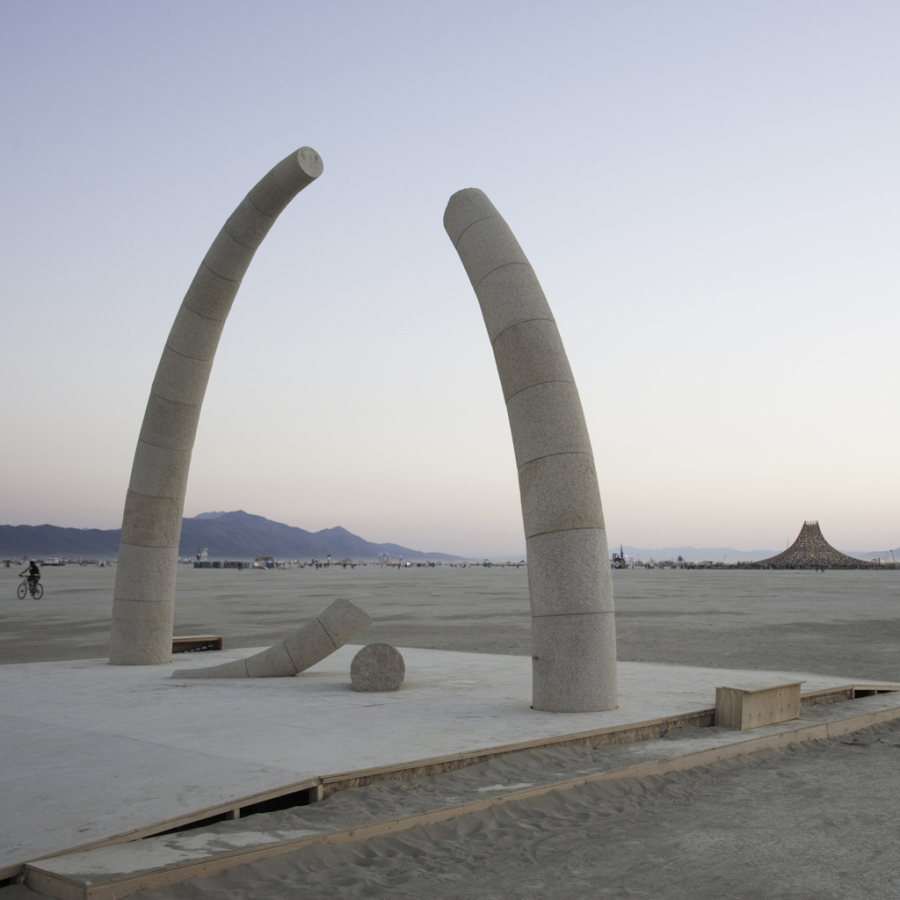
The completed Resolute Arch on the playa at Burning Man. The 25-ton granite sculpture won top honors at the festival.
Connecting with students
You have to read poetry, listen to other kinds of music ... broaden your universe. It's a big world out here. Your brain is powerful and will get you far, but to really get into mastery, you have to engage all those other parts of yourself too.”
Since arriving at the UW, Rhodes has been lecturing in structural analysis courses, meeting with faculty across the department and working to connect his expertise to the questions students are already wrestling with.
“I love having the opportunity to enter into deeper conversations with students — what are your goals? What are you trying to do in your career? How are you thinking about these materials?” he says.
The professorship has also taken him beyond campus. During a trip to India earlier this year, Rhodes connected with UW's Grand Challenges Impact Lab study abroad group in Bangalore, where he took students to see a 58-foot-tall sculpture of a Jain saint carved from a single stone — one of the largest monolithic sculptures in the world and a site that Rhodes says almost no one outside India has heard of.
The most important thing that Rhodes hopes to leave with students is not a lesson about stone, but rather a way of thinking. He urges them to look beyond their specialization and to understand that mastery in any field requires more than technical skill alone.
"You have to read poetry, listen to other kinds of music ... broaden your universe," he says. "It's a big world out here. Your brain is powerful and will get you far, but to really get into mastery, you have to engage all those other parts of yourself too."
It is the kind of advice that might sound surprising in a civil and environmental engineering classroom. But for a department preparing students to design and steward the infrastructure of the future, Rhodes's presence as the Burges Visiting Professor is a reminder that the built environment has always been shaped by more than calculations alone.
Richard Rhodes is the 2025-26 Burges Visiting Professor in the Department of Civil and Environmental Engineering at the University of Washington. His book, "Stone: Ancient Craft to Modern Mastery," is available from Princeton Architectural Press.
Originally published April 7, 2026