
By Julia Davis
June 1, 2026
A new treatment for chronic kidney disease (CKD) born out of CEE research might look more like a trip to a boba shop than a visit to the doctor.
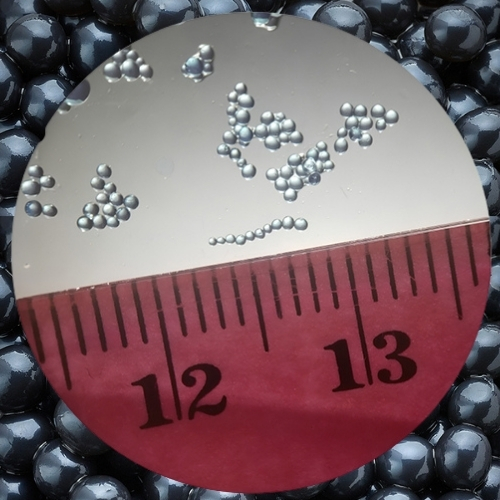
Hydrogel beads developed in the Winkler Lab resemble the tapioca pearls found in bubble tea. A microscope view shows the beads are roughly 1 to 2 millimeters in diameter. Photo courtesy of the Winkler Lab.
The concept: swallow tiny gel beads similar to the tapioca pearls in bubble tea, but loaded with bacteria designed to intercept harmful toxins in the gut before they ever reach the bloodstream. For the roughly 37 million Americans living with CKD, it could mean managing the disease earlier and reducing reliance on dialysis.
The research originated in the Winkler Lab, where Professor Mari Winkler's environmental engineering group has spent years developing hydrogel bead technology for applications like wastewater treatment. The kidney disease project applies that same encapsulation expertise to a new problem, and Winkler says the connection is more direct than it might seem.
"We are using wastewater treatment principles to clean the gut so that kidney patients have fewer toxins go into the blood," says Winkler.
Most uremic toxins, the harmful substances that build up when kidneys can't filter properly, are produced by bacteria living in the gut. Patients currently rely on medication and dialysis to manage these toxins, but some can bind tightly to proteins in the blood, making them nearly impossible to filter out with existing treatments.
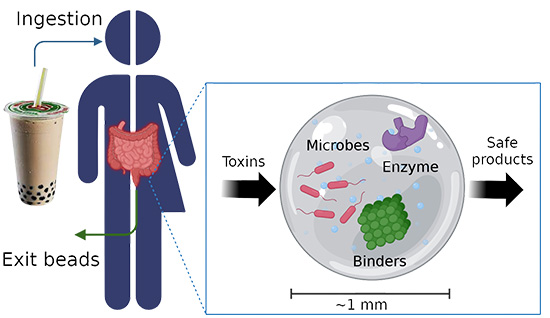
A diagram shows how the hydrogel beads work: after ingestion, toxins pass into the bead, where microbes, enzymes and binders break them down into safe products. Image courtesy of the Winkler Lab.
The Winkler Lab approaches the problem from a different direction: rather than trying to remove toxins from the blood after the fact, the gel beads work upstream in the digestive system. The gel is porous, so as the beads travel through the gut, toxins pass through the gel wall and into the bead, where the bacteria inside break them down. The bacteria themselves never leave — they stay contained in the bead, protected from stomach acid and digestive enzymes, and the beads eventually pass through the body naturally.
CEE doctoral student Pei-Hsin Wang has spent more than three years testing how different bacterial strains remove various toxins, using hydrogel encapsulation methods developed by research scientist and lab manager Bruce Godfrey.
The research has since been spun into a company called Thera-T, with a team of CEE and Foster School of Business students working to move the technology toward patients. CEE graduate student Ming-Che Chung recently joined the team to support Thera-T's research and development efforts.
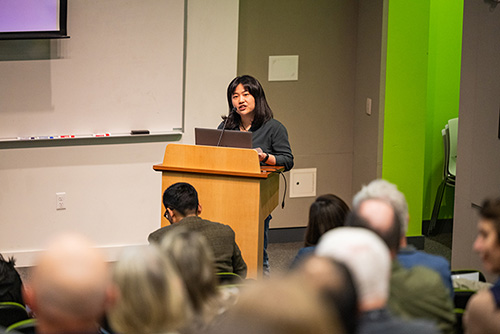
CEE graduate student Pei-Hsin Wang pitching during the CoMotion Innovator Showcase in 2025.
In November, Wang pitched the work at the CoMotion Innovator Showcase, where attendees voted it the top project out of five UW research presentations. The Thera-T team built on that momentum at the 2026 Hollomon Health Innovation Challenge, where they earned the $10,000 WRF Capital Second Place Prize.
“There is a gap between the lab and the market; you have to convey your research in a way people can really understand,” Wang says. “Seeing people get excited about the idea showed me that this is a need in kidney disease treatment, and people want other technologies in this space.”