
September 25, 2026
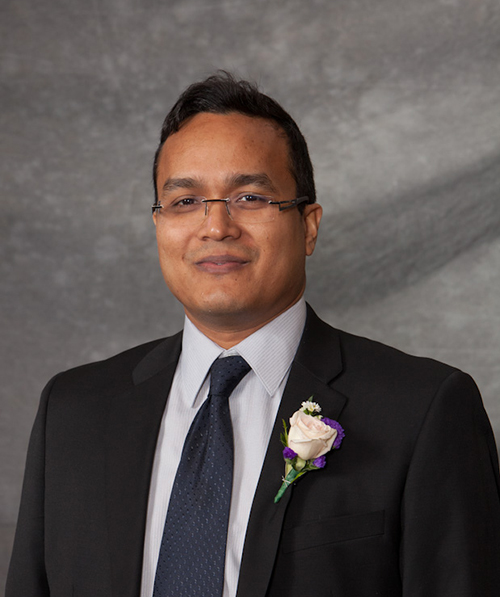
Faisal Hossain
The CEE professor turns satellite data into tools that help agencies manage water around the world.
CEE Professor Faisal Hossain has made it his mission to put information about water within reach of every nation and every person. For much of his career, he has pursued that goal by helping countries use satellites to monitor their rivers and reservoirs and plan for floods and droughts. He has also made films, written children's books and started a student film contest to share science with people outside academia.
Now the American Geophysical Union (AGU) has honored Hossain, John R. Kiely Endowed Professor in CEE, with its 2026 Ambassador Award. The award recognizes contributions in areas such as societal impact, service to the Earth and space community, scientific leadership and promoting talent and careers in the field. It honors achievements that extend beyond those covered by traditional scientific discipline awards. AGU presents only one to five Ambassador Awards each year across an international membership of about 60,000 scientists. The award also inducts Hossain as an AGU Fellow.
The Ambassador Award is both humbling and deeply meaningful to me. It reflects the collective efforts of my students, colleagues and collaborators who have worked tirelessly to bridge science and practice in ways that improve lives and strengthen society.
Faisal Hossain
"The Ambassador Award is both humbling and deeply meaningful to me," Hossain says. "It reflects the collective efforts of my students, colleagues and collaborators who have worked tirelessly to bridge science and practice in ways that improve lives and strengthen society."
Putting satellite data to work
Hossain's research combines hydrologic remote sensing, which uses satellites to observe water from space, with water resources engineering and management. His group focuses on what it calls crossing "the last mile": delivering research in a form others can put to use.
That approach has led to water management systems now owned and operated independently by national and regional agencies in Southeast Asia, the Middle East and the United States. His current NASA-funded projects include work with the Mekong River Commission and SERVIR-Mekong to strengthen flood and drought management in the Lower Mekong region, and the use of multiple satellites to monitor both the amount and quality of water in reservoirs.
Hossain served as applications lead for the science team of the Surface Water and Ocean Topography (SWOT) satellite mission from 2016 to 2022 and as co-chair of Mesopotamian River Revival, a U.S. Department of State science and technology initiative with Iraq. He has published more than 190 peer-reviewed journal articles, and his second textbook, "Satellite Remote Sensing for Water Management," was published by Cambridge University Press in 2025.
Science on screen and on the page
Beyond his research, Hossain looks for ways to get people excited about science. In 2017, he launched the UW's Student STEM Film Contest, the nation's first film contest for STEM majors. His own films include "Cotton Fields from the Ivory Tower," which was selected for AGU Cinema and several other festivals in 2017. He recently finished his sixth film, "The Silent Route," an 8-minute animated short based on a personal story that took six years to make.
He has written and edited illustrated children's books, including the two-volume "The Secret Lives of Scientists, Engineers and Doctors" (2020) and "Robots and Other Amazing Gadgets Invented 800 Years Ago" (2022), to encourage young readers to explore how the natural world works.
The Ambassador Award is Hossain's third AGU honor, after the Charles Falkenberg Award in 2012 and the International Award in 2020. In 2022, he was named a Fellow of the American Meteorological Society and of the American Society of Civil Engineers' Environmental and Water Resources Institute. He will be recognized at AGU's annual meeting in San Francisco in December.
Related stories
Tribal partnerships
Predicting river temperatures
Doctoral student George Darkwah and Hossain built a tool that uses NASA satellite images to track river temperatures, helping tribal fishery managers protect salmon in the Columbia River basin.
Global engagement
Advancing surface water tracking in Bangladesh
Hossain and his research group trained engineers and scientists in Bangladesh to use data from the SWOT satellite mission to monitor rivers and plan for floods and droughts.