
June 5, 2026
Congratulations to students, faculty and researchers who have received awards, scholarships and other honors.
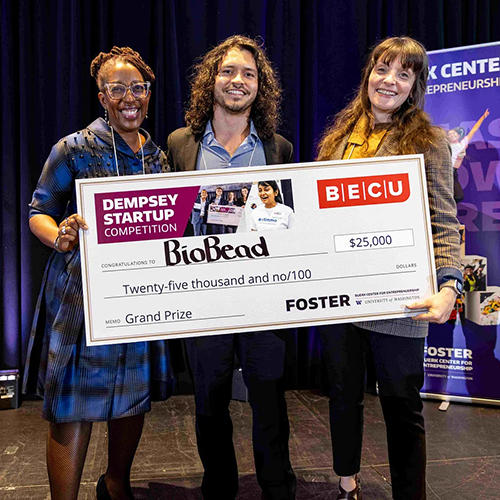
BioBead, a startup co-founded by Professor Mari Winkler, CEE postdoctoral researcher Korena Mafune and Ph.D. student Renee Davis, won the $25,000 BECU Grand Prize at the 2026 Dempsey Startup Competition, hosted by the Buerk Center for Entrepreneurship in the UW’s Foster School of Business. The team is developing small, biodegradable pellets that deliver beneficial bacteria and fungi to soil, helping crops absorb nutrients like nitrogen and phosphorus while reducing the need for fertilizer. Recent Foster School of Business MBA graduate Jared Espinosa joined the team for the competition. BioBead also won the $2,500 Voyager Capital Best Business to Business Idea Prize.
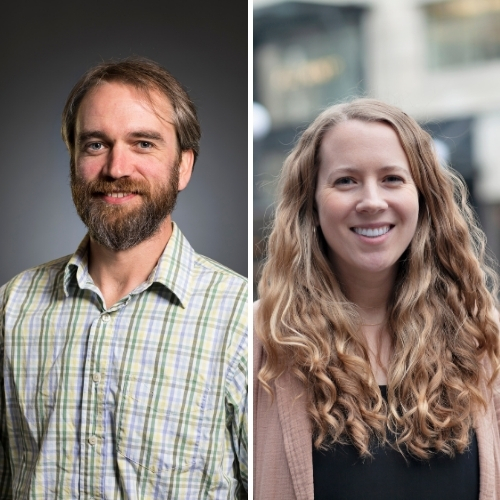
Professor Jeffrey Berman and Sarah Wichman (CEE Ph.D. '23), now a structural designer at KPFF, received the 2026 Norman Medal from the American Society of Civil Engineers as part of the team behind the paper "Shake-Table Testing of a Full-Scale 10-Story Resilient Mass Timber Building." The research tested how a 10-story mass timber building performs in simulated earthquakes. The Norman Medal, first established in 1872, is awarded annually to a paper that makes a significant contribution to engineering practice or research.
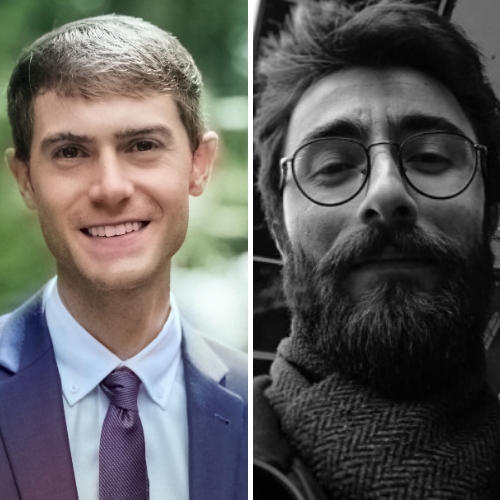
Associate Professor Brett Maurer and Mertcan Geyin (CEE Ph.D. '21), who is now at the Norwegian Geotechnical Institute, received the 2026 J. James R. Croes Medal from the American Society of Civil Engineers. The award recognized their paper, co-authored with Sjoerd van Ballegooy, on a cost-benefit framework for protecting lightweight homes from earthquake-related soil liquefaction.
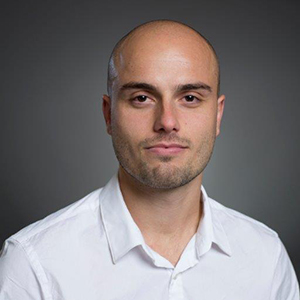
Associate Professor Paolo Calvi received the 2025 Anti-Seismic Systems International Society’s Global Design and Innovation Award in the research category as part of an international team. The group conducted a first-of-its-kind test on a building in L’Aquila, Italy, that was built on special devices designed to absorb earthquake shaking, after a major earthquake struck the city in 2009. The test offered rare real-world data on how these protective systems hold up over time.
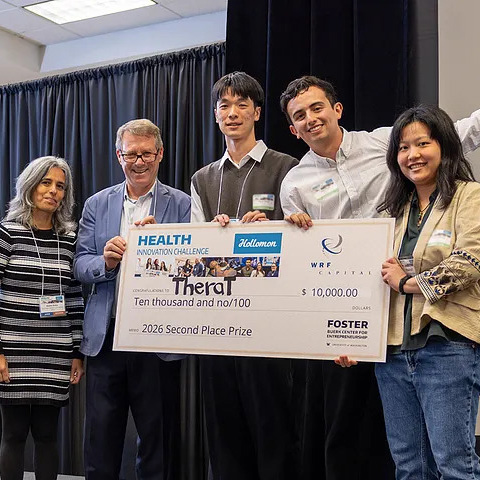
Team Thera-T, which includes Ph.D. student Pei-Hsin Wang, won the $10,000 WRF Capital Second Place Prize at the 2026 Hollomon Health Innovation Challenge, hosted by the Buerk Center for Entrepreneurship in the UW’s Foster School of Business. The team's drinkable therapy uses technology developed in the Winkler Lab to remove toxins in the gut, helping chronic kidney disease patients reduce their reliance on dialysis.
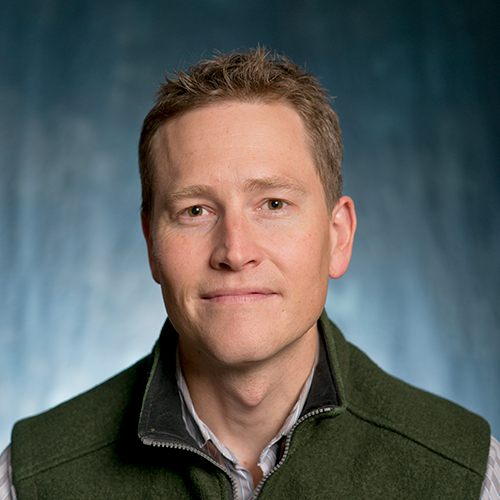
Professor Jim Thomson was part of a research team that received the 2025 Excellence in Partnering Award from the National Oceanographic Partnership Program (NOPP) for their NOPP Hurricane Coastal Impacts project. The effort brings together researchers from across academia, government and industry to better predict how hurricanes damage coastlines, including effects like beach erosion, barrier island breaching and property damage.
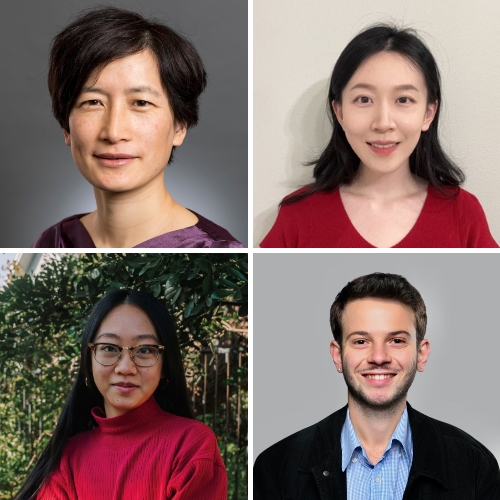
Professor Cynthia Chen, Grace Jia (CEE Ph.D. '25), Kaitlyn Ng (MSCE '24) and Ekin Ugurel (CEE Ph.D. '25) received the 2026 Exceptional Technical Achievement Award from the Zephyr Foundation for their paper on how telecommuting has changed travel behavior. The research, out of Chen's THINK Lab, found that remote work reduces vehicle miles traveled and shifts transit needs, with telecommuters making more local trips for non-work activities. The team also included Brian Lee of the Puget Sound Regional Council and Arizona State University Professor Ram Pendyala.
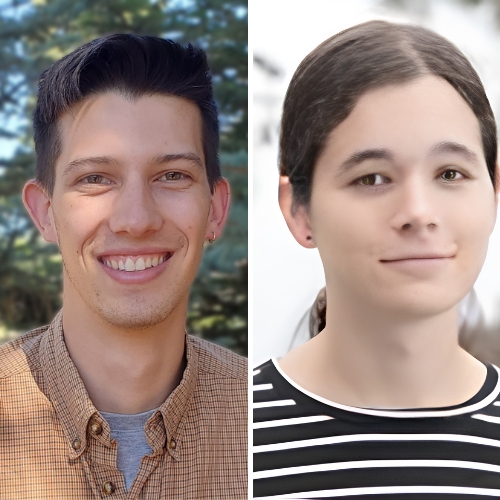
CEE postdoctoral researchers Quinn Brencher and Cassandra Henderson were among 16 UW fellows funded by a $2.5 million grant from the Gordon and Betty Moore Foundation. Brencher's research uses satellite data and machine learning to improve measurements of snow and ice for water resource management and natural hazard monitoring. Henderson's work focuses on preparing Washington communities for climate change through the Puget Sound Coastal Storm Modeling System, which supports long-term flood planning that accounts for sea level rise.
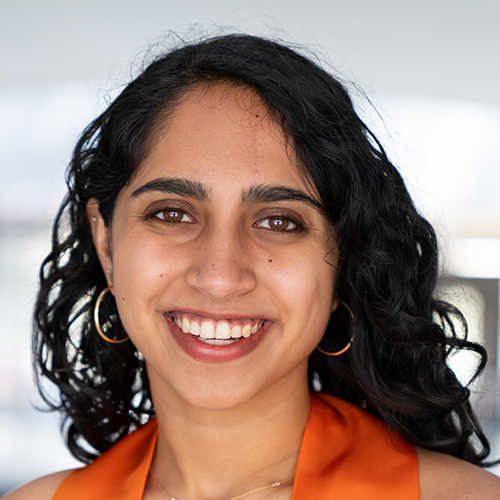
Ph.D. student Rubina Singh received an Outstanding Student of the Year Award from the Council of University Transportation Centers, presented at the Transportation Research Board Annual Meeting in January. The award recognizes top students from participating University Transportation Centers based on research, academic performance, professionalism and leadership.
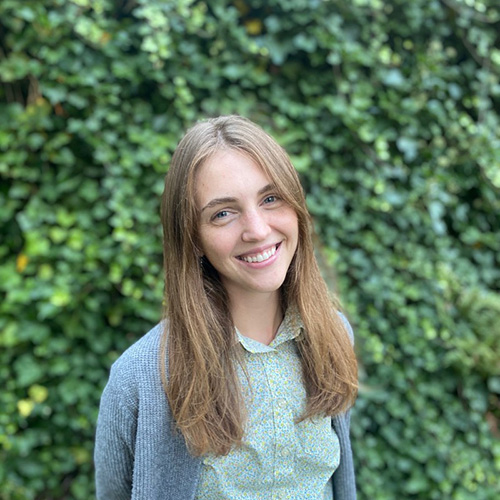
Ph.D. student Morgan Sanger received the Helene M. Overly Memorial Graduate Scholarship from the Women's Transportation Seminar International, a $10,000 award that encourages women to pursue careers in transportation. The scholarship is based on academic record, transportation-related goals and job skills.
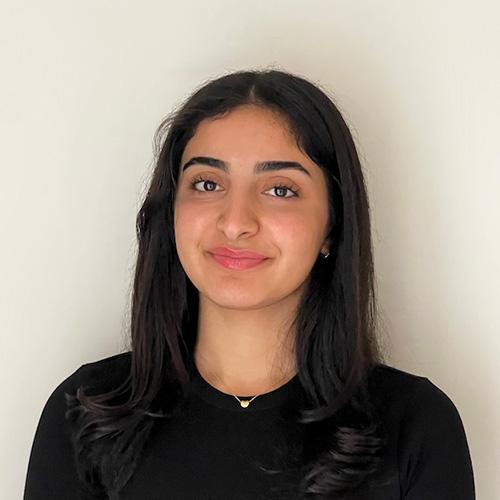
Environmental engineering student Kiana Gholamy received a 2026 Undergraduate Research Award from the Washington Clean Energy Testbeds. The $3,000 award supports her project upcycling waste tire rubber into a carbon-based material that can capture tire-derived contaminants from water, a step toward cleaning up a major pollutant using its own source material.
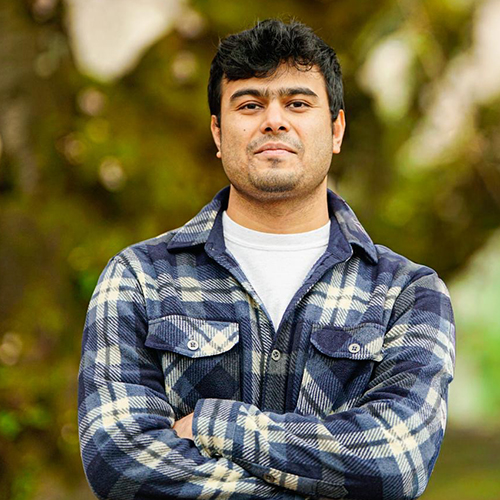
Shahzaib Khan (CEE Ph.D. '26) received the Ronald and Mary Nece Endowed Fellowship, awarded annually to a top Ph.D. student in the hydrology and hydrodynamics program based on their dissertation, scholarship and academic performance.