
By Julia Davis / Photos by Matt Hagen
July 31, 2026
Students presented capstone and research projects, and three teams won awards, at the department's first-ever showcase this spring.
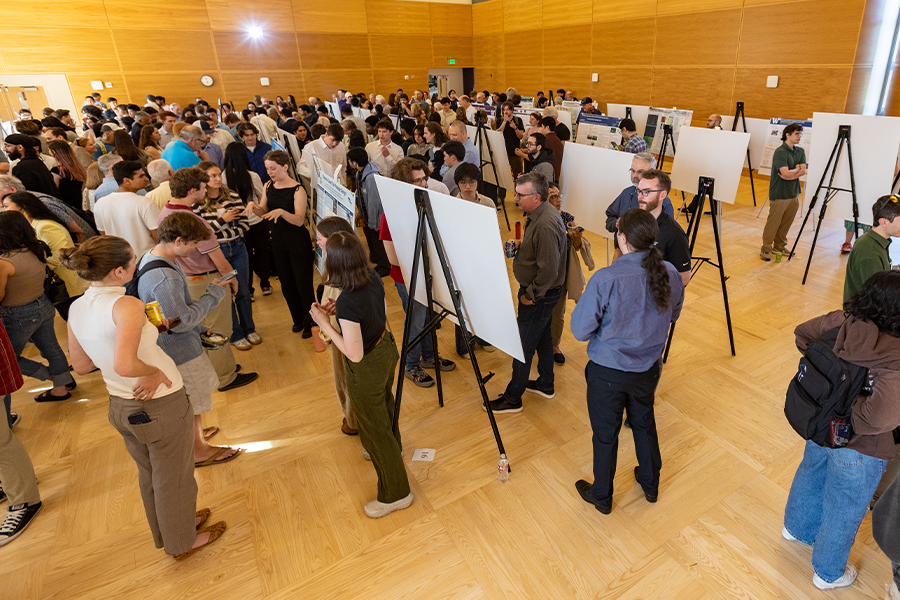
Students, faculty, alumni and industry guests fill the HUB Lyceum.
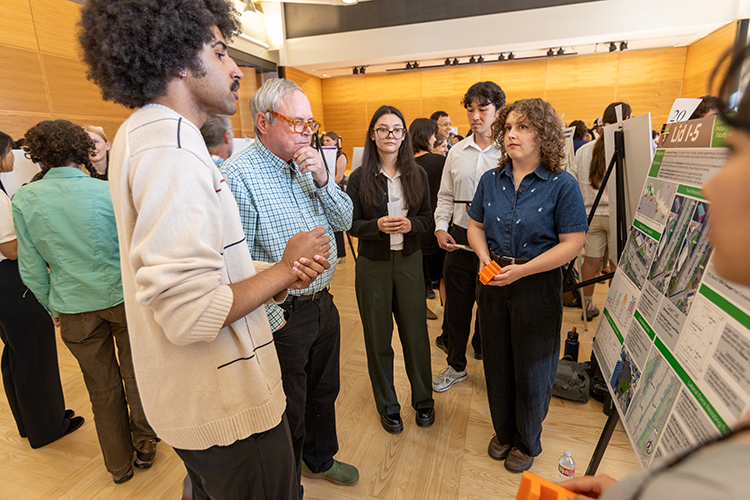
Students discuss their Lid I-5 capstone project, which explored structural systems for a lid over Interstate 5 in downtown Seattle.
This spring, CEE held its first Capstone & Research Showcase — and if the crowd was any indication, it won't be the last. Students, faculty, alumni and industry guests packed the HUB Lyceum on May 27 as senior capstone design teams presented their work in a friendly poster competition, alongside research exhibits from across the department.
The capstone teams can take two forms. In traditional capstone courses, students in a larger class work in small groups on variations of the same project. In industry capstone projects, a small team collaborates with a sponsoring organization on one unique problem from that organization's own work. This year's industry sponsors included the Washington State Department of Transportation (WSDOT), Snohomish County Public Utility District (PUD), Bechtel, Amazon, Lid I-5 and BHC Consultants, among others.
"The students really took it, ran with it and were very excited," says Associate Professor Richard Wiebe, who organized the showcase with Associate Professor Paolo Calvi. "The advisers liked it, and we got some amazing feedback from our industry partners.”
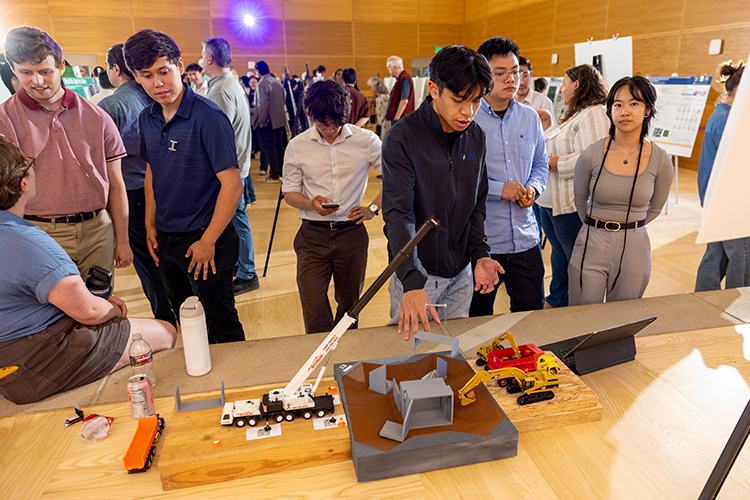
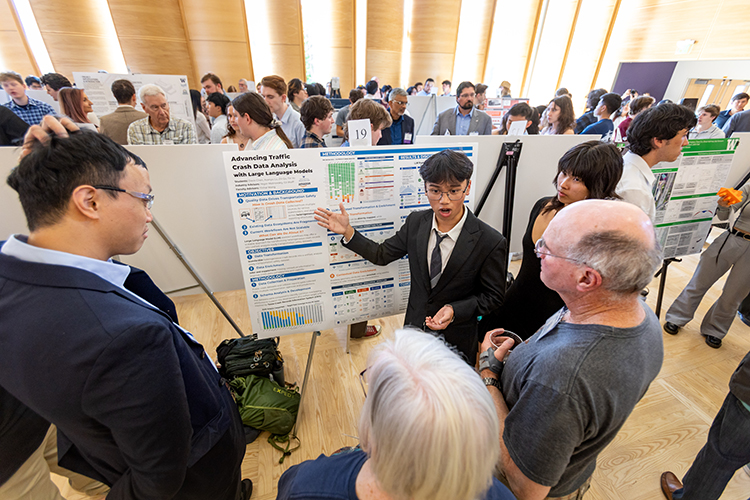
Left: A student walks guests through a scale model of the SR203 Horseshoe Lake fish passage construction site, part of a heavy civil construction capstone with WSDOT. Right: A student presents his team's Amazon-sponsored capstone on using large language models to analyze traffic crash data.
From floating gates to rooftop power
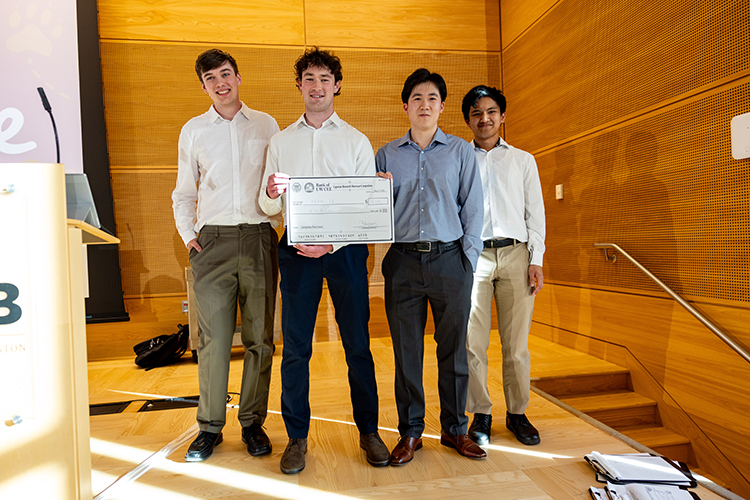
Winners of the Outstanding Project Award for Buoyant Gate for Spada Lake Spillway: Josh Douglas, Rohan Young, Hong Deng and Careu Tapang (from left to right).
A panel of judges from industry, the department's external advisory board and faculty selected three winning teams, whose awards were co-sponsored by the Pacific Northwest Transportation Consortium (PacTrans). The top prize went to an idea that surprised even the project's sponsor. When Snohomish County PUD asked a team of CEE students to explore ways to store more water in Spada Lake, the students proposed a seasonal floating gate for the dam's spillway, an idea that neither the utility nor the team’s advisers had thought of.
"The students came up with this idea themselves,” Wiebe says. “It was a really clever approach to solve the problem."
The project earned the Outstanding Project Award. Team members Hong Deng, Careu Tapang, Rohan Young and Josh Douglas designed a concept for seasonally raising the spillway at Culmback Dam, which forms Spada Lake — the reservoir that supplies water to much of Snohomish County. Storing more water in late spring would help the utility meet demand through summer and fall as snowpack becomes less predictable.
Best Poster went to Team Water2Watts — Willa Cooksey, Kyle Ritchie, Veronica Riling, Peyton Groshart, Paulinne Anaya and Otoniel Velasquez-Paz — for exploring whether rainwater running off the roofs of UW buildings could be captured and converted into electricity through a low-cost micro-hydropower system.
Best Presentation went to Team Pacific Structural — Indiana Easter, Chase Bigger, Kathryn Johnston, Hans Wendler, Evan Blankenship, Ethan Vuong and Prabhpartap Khattra — for their structural design of Hawkins Hall, a hypothetical new engineering building that would replace More Hall, CEE's own home on campus. Working as a mock firm with guidance from KPFF Consulting Engineers, the team took the building from foundation design through seismic analysis.
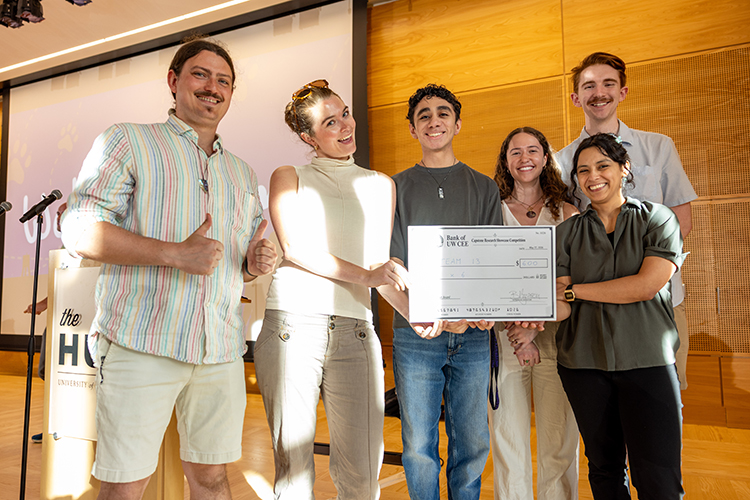
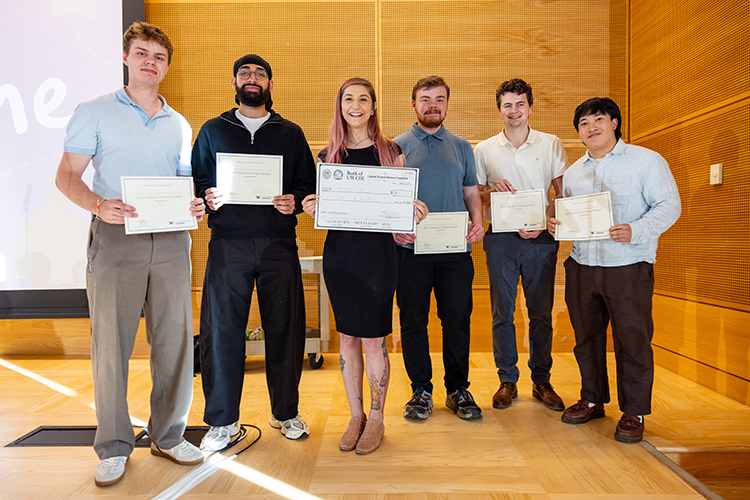
Left: Winners of the Best Poster award, Team Water2Watts: Peyton Groshart, Willa Cooksey, Otoniel Velasquez-Paz, Veronica Riling, Paulinne Anaya and Kyle Ritchie (from left to right). Right: Winners of the Best Presentation award, Team Pacific Structural, for their structural design of Hawkins Hall: Hans Wendler, Prabhpartap Khattra, Kathryn Johnston, Chase Bigger, Evan Blankenship and Ethan Vuong (from left to right).
A push to grow industry capstone projects
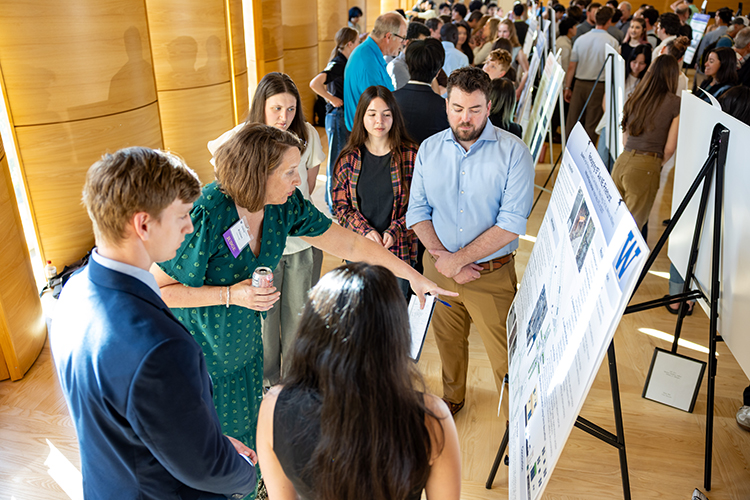
Judge Kris Overleese, an External Advisory Board member and president and CEO of KBA Inc., discusses a project with students.
In the past, CEE has had industry capstone projects here and there, but this year Wiebe and department chair Bart Nijssen set out to expand the program. Thirty CEE students worked on nine industry capstone projects — six led by the department and three led by other departments with CEE students on the teams. Through the College of Engineering's Industry Capstone Program, sponsoring organizations propose an actual engineering problem from their own work, then mentor a student team through a full design process from January to June.
The work is already making its way off campus. Some sponsors are now looking at implementing their teams' designs.
“The problems our region is working on, from water supply to transportation, are the problems our students want to work on,” Nijssen says. “Watching our students impress the industry mentors who tackle these problems every day with their own creative solutions is why we're excited to keep building this program."
The problems our region is working on, from water supply to transportation, are the problems our students want to work on. Watching our students impress the industry mentors who tackle these problems every day with their own creative solutions is why we're excited to keep building this program.”
Bart Nijssen
CEE Department Chair
Learning that runs in both directions
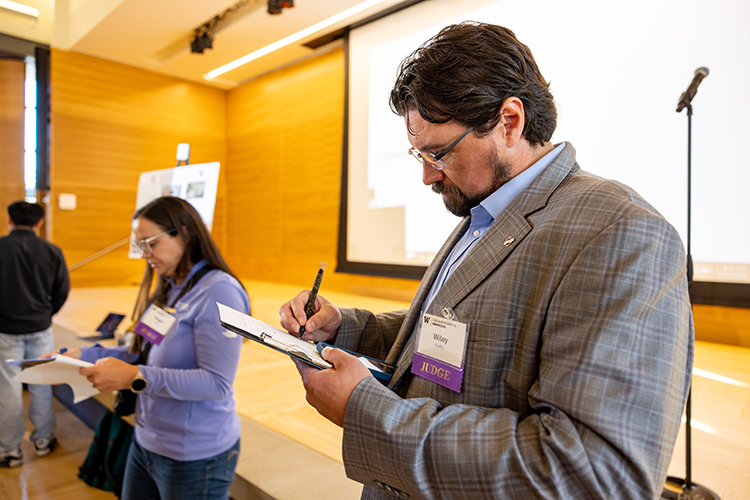
Judge Wiley Coffin (BSCE '05), an External Advisory Board member from Bechtel, takes notes.
For students, the industry projects offer something a course can't easily replicate.
"It was really refreshing for the students to get a chance to learn from the industry mentors about implementation — how do you make this work in the real world?" Wiebe says. Students have to bridge the gap, he explains, between the theories they learn in class and an applied problem without a clear path to a solution.
Industry mentors bring experience that academics may not have, he adds. "People in industry have experienced scenarios and situations we either haven't seen at all or haven't encountered in some time. It's especially valuable when students get to work with both faculty and industry mentors."
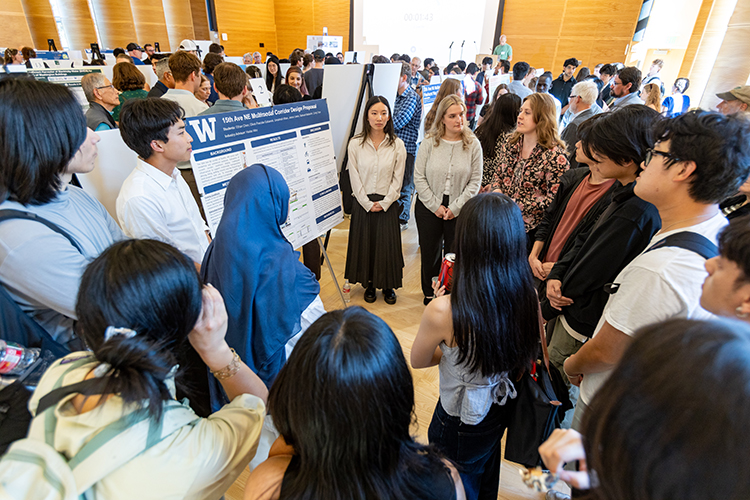
A team presents their multimodal corridor design proposal for 15th Avenue NE.
Sponsors, in turn, see familiar problems through fresh eyes and get to know students they might one day hire. But Wiebe suspects many mentors are drawn by something simpler.
"I think a lot of the engineers really enjoy the enthusiasm students bring, along with the excitement and creative ideas they come up with," he says.
With strong interest from both students and sponsors, the department is already planning to expand the industry capstone program and bring the showcase back next year.
Become a sponsor
Organizations interested in sponsoring a capstone project can learn more through the UW Engineering Industry Capstone Program.