
From earthquake resilience to landslide mitigation, geotechnical engineering research addresses the challenges that arise where the earth and the built environment meet. By understanding the behavior of soil and rock, researchers develop solutions that improve safety and reliability in infrastructure.
Overview
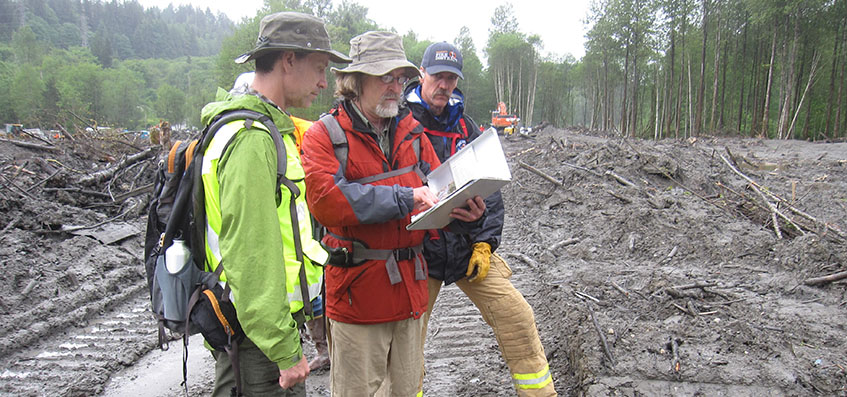
Geotechnical engineering research examines how soil and rock behave and how they interact with natural hazards, infrastructure and the environment. Faculty and students use modeling, lab experiments and field studies to advance knowledge in soil and rock mechanics, foundation engineering, bio-geotechnics and reinforced soil systems.
Our geotechnical engineering faculty take an interdisciplinary approach, collaborating with experts in structural engineering, mechanics, geology, seismology, remote sensing and statistics. Research is supported by federal and state agencies, including the National Science Foundation, the U.S. Geological Survey, the Pacific Earthquake Engineering Research Center and the Washington State Department of Transportation.
Research topics and associated faculty
Soil mechanics
Geologic hazards
Foundation engineering
Geotechnical earthquake engineering
Computational geomechanics
Labs and centers
CEE faculty lead research labs as well as larger centers housed in the department. Labs focus on advancing faculty-led research with student participation, while centers are generally funded by industry and government to coordinate research on specific themes and connect faculty, students and partners through education and outreach.
Professional societies
- ASCE Seattle Section Geotechnical Group
- Geo-Institute Graduate Student Society (GIGGS) UW Chapter
- Earthquake Engineering Research Institute
- Geotechnical Extreme Events Reconnaissance
Degree programs
What is the geotechnical field?
This 5-minute video produced by the DFI Women in Deep Foundations (WiDF) Committee answers the question: “What is the geotechnical field?”