
Hydrology and hydrodynamics research focuses on how water moves through natural systems and how those processes shape ecosystems, infrastructure and communities. This work supports better understanding and management of water resources across rivers, coasts and watersheds.
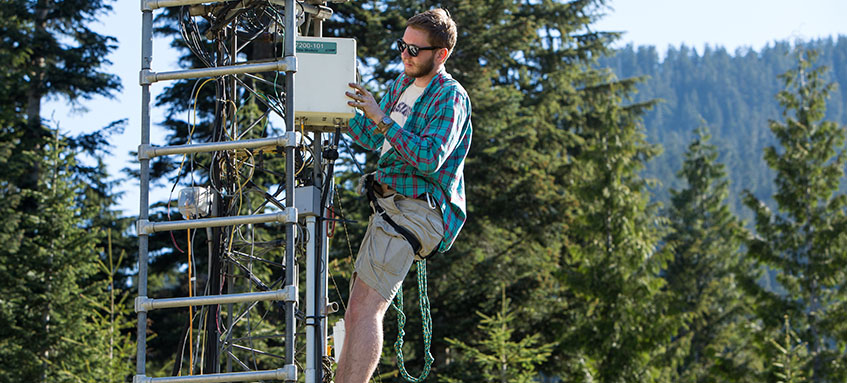
Overview
Research in hydrology and hydrodynamics focuses on the movement, distribution and quality of water, as well as the behavior of fluids in natural environments. Faculty and students study these processes to better understand water availability, flooding, sediment transport and ecosystem response.
Hydrology research centers on monitoring and predicting water resources, from streamflow and snow- and glacier-fed runoff to groundwater and water quality. This work also examines how water systems respond to changing conditions such as drought, contamination and climate variability.
Hydrodynamics research focuses on how water and other fluids move in natural environments such as rivers, estuaries and coastal systems. Research draws on field observations, numerical modeling and laboratory experiments, including work conducted in the department’s Harris Hydraulics Laboratory, a shared facility that supports research and teaching in environmental fluid mechanics.
Research topics and associated faculty
Hydrodynamics
Morteza Derakhti, Christie Hegermiller, Alexander Horner-Devine, Jim Thomson
Labs and centers
CEE faculty lead research labs as well as larger centers housed in the department. Labs focus on advancing faculty-led research with student participation, while centers are generally funded by industry and government to coordinate research on specific themes and connect faculty, students and partners through education and outreach.